Reality Tunnels and the Mandela Effect

I tend to do a lot of great thinking (at least for me) while driving. I don’t know if this is really a good thing, but I enjoy it and I’ve not wrecked because of it (yet). I’ve come up with a lot of interesting story ideas this way, and when I do, I tend to add them to a running list of ideas that will probably never see the light of day. Not because the ideas aren’t good, but because I only have a finite number of years on this earth and I’m not the most prolific writer, so I’ll probably never even get through half of the ideas I’ve already come up with. But I like having these thoughts, and even if I don’t usually share them with anyone else, I find them intriguing and occasionally useful. Sometimes I add bits and pieces of them to other stories I’m working on.

While I don’t usually share my random thoughts, especially ones that I would like to eventually use for a book, this one was very intriguing and I could see it being used in a hundred different ways, so I decided to do a post on it, just to give you insight into how my mind works.

The whole idea started with just a simple thought: everyone sees the world through their own senses, their own experiences, so in a way everyone is secluded in their own reality. It turns out that I’m not the first person (Imagine That!) to have this idea (see Reality Tunnel) but that was the initial thought that got the possibilities racing through my mind. The idea I liked the most was that each of our reality tunnels is being created by an individual A.I. which is linked to all the other A.I.s controlling all the other reality tunnels. The purpose of the A.I.s is to
move us in certain directions and direct us towards certain goals which have been determined by a master program to be the best for everyone. There are two problems with this arrangement though; our reality tunnels must intersect with other reality tunnels and regardless of the reality we experience, we have free will.

This idea opened up so many questions which could lead to a great story such as: Who created the A.I.? What if the master program A.I. starts to break down? Can we, as individuals influence or even get control of our reality tunnel? What happens if our reality tunnel merges with another and there are inconsistencies/errors? Could this explain the Mandela effect?

Seriously, if you don’t know what the Mandela effect is, google it. There are so many great examples, but the name comes from a commonly held memory of Nelson Mandela dying in the ‘80’s. I don’t have many memories as a kid in the ‘80’s but I vividly recall reading about Mandela’s death in one of those elementary-school age magazines the teachers made us read when they needed some quiet time. It turns out he actually died at the end of 2013.

There are quite a few other examples too such as “The Berenstein Bears” are actually named “the Berenstain Bears”, the Monopoly man doesn’t really have a monocle, and Sinbad never played a genie in a movie called Shazaam, though I swear he did (see more examples here). I like incorporating real-world details into my books and I could see using these like a trail for the protagonist to follow. I don’t know if any of this will eventually make it into a book, but I love the mind exercises and I hope you enjoyed a brief look into my thought process.
On Writing

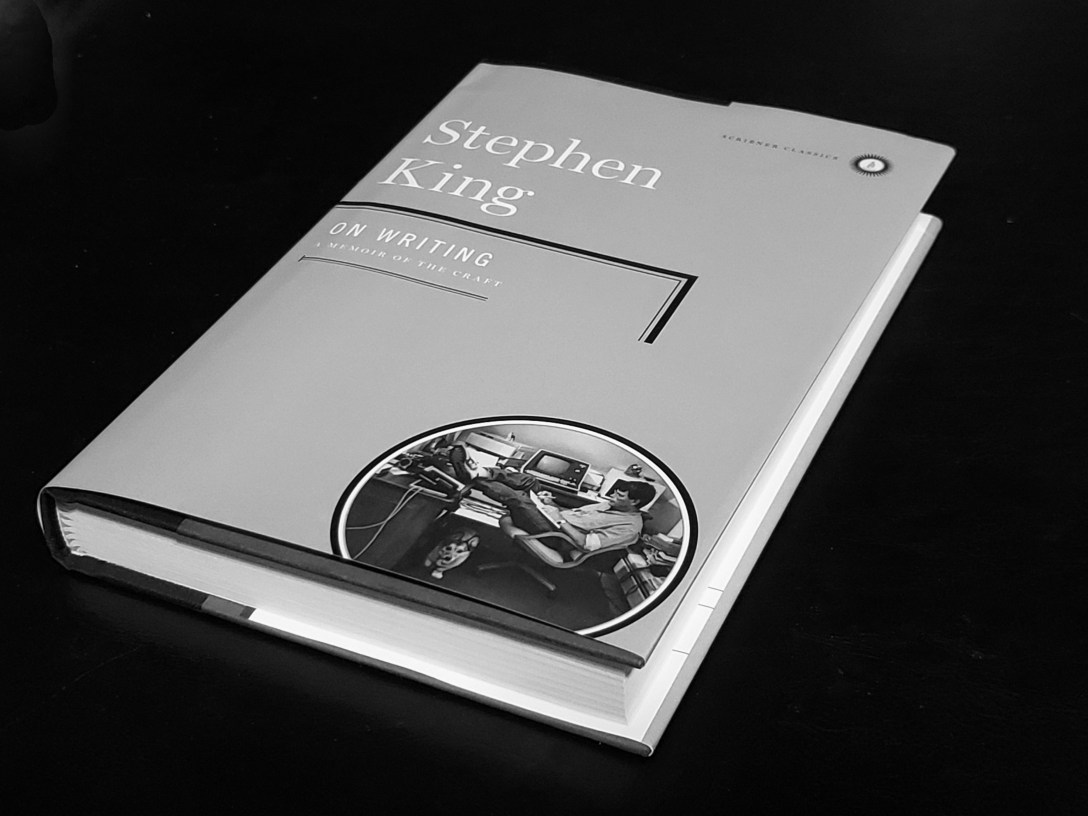
Thanks to my mother, I’ve finally been able to read Stephen King’s book “On Writing: A Memoir of the Craft” and for anyone interested in writing, I cannot recommend the book enough.

Until you read the book, it’s kind of hard to understand how good it is, and even after reading it, I find it hard to truly describe what makes it so good. The book is part autobiography, and part philosophy of writing. Even though I’m not a huge fan of King, (I am far from fanatical about anything he’s done, except maybe “The Shawshank Redemption” which is based off his novella “Rita Hayworth and Shawshank Redemption“) I really enjoyed reading the biographical parts of the book; they’re funny, insightful and honest. But the best parts were the ones where he gets down to the nitty-gritty on writing.

Contrary to what most aspiring authors might want, this book is anything but a how-to manual on becoming a writer. King gives a background on how he became a published author and he even gives a basic example of how others have, but mostly he shares his wisdom on what it takes to write a good story. The funny thing is, even though I’ve heard most of it before, or figured it out for myself over the past several year, it’s the way he shares his knowledge that really hits it home. I could try to paraphrase everything he says in this book, and you can find others who have pretty much done so in different “How to be a writer” type blogs and discussion boards, but it won’t have the same impact. King’s ability to say just the right things in just the right way is uncanny.

And honestly, I didn’t really gather any new advice from reading “On Writing” but it did have a great impact on me. Most of what I read just helped validate or reiterate what I’ve learned these past few years as I wrote my books; but that validation was more valuable than I would have expected. And if I did learn anything from reading this book, it’s that it is okay to be a writer, and that’s one of the most valuable things I could ever learn.

My Life As Death

I’ve talked a little before about my latest work-in-progress My Life As Death, but I wanted to go a little more in-depth about it. The idea for the book is basically this:

On the eve of his senior year, almost-eighteen year old Nathaniel (Nate to his friends) gets into a drunken accident, totaling his car and ending his life, or so he thought. In the darkness of death, a face appears and offers him a deal; agree to become a Grim Reaper (yes, there’s more than one Grim Reaper), send 10 well deserving souls to the afterlife and he will get to finish out the life he was meant to live. Fail to reap all 10, and Nate will forever be a servant of death.

Now Nate’s not a homicidal maniac; to the contrary, he actually doesn’t like the idea of having to kill anyone, but he’s guaranteed to only have to reap the truly evil, the murderers, rapists and child molesters. How could anyone have a problem with getting rid of those people? Right? Upon touching the guilty party, Nate will even see their evil deed and know the punishment is deserved. Then he just has to decide how they’ll die. But not everything is as simple as it seems, especially when everyone has secrets.

I don’t know exactly why the plot intrigued me so much, but the idea of trying to get through high-school and deal with being a part-time agent of death wouldn’t go away. And it might not just be the plot itself, but the characters that kept me going back to it. I put a bit of myself, my friends and my experiences into each of my books, but this one seems to have a lot more of me in it. While writing this book I tend to listen to more of the songs from my teenage years than normal. I reminisce a lot more than I ever have. I’m only about a third of the way through the book, but I already feel so drawn into it that it’s hard to focus on any of my other works-in-progress. But that’s a really good thing, because this is going to be the first book I try to get a traditional publishing contract with so the sooner it’s done, the better.

And just incase anyone is wondering about the graphic at the top of this post – no, that is not indicative of what the book cover will look like. I have several different ideas for the cover, but I’m nowhere close to deciding what it should be. But I think the skull graphic does share the same feeling as the book. It’s a little dark and creepy, a little cute and funny. And I think that’s a good way to describe the book.

Ghost Writing and Plagiarism

There are some interesting articles over at The Passive Voice (specifically this one and this one) dealing with ghost writing and plagiarism, and I was kind of surprised by the scope of the situation. I mean, from a business perspective, hiring ghost writers makes sense, I guess. James Patterson is well known for “working with” other authors to crank out books at a ridiculous pace and it seems to pay off very well for him, so why wouldn’t other “authors” use the same system? Well, I can only speak for myself, but I have several reasons why I couldn’t use ghost writers that go beyond the fear of plagiarism.

I really don’t think I could use a ghost writer, even if I wanted, because most of the time I don’t know what is going to happen in any of my stories. I tried writing a plot outline for The Dark Genesis of Daniel James, but it took way too much time, and I ended up deviating from it so completely that it was pointless. Now, instead of trying to plot out anything, I just listen to the characters as they develop and let them tell me what’s going to happen.

I also couldn’t use a ghost writer because James Patterson uses one. I like James Patterson’s books; I’m not as fond of the ones written “with” other writers. They don’t have the same feeling, the same voice. Just because he came up with the story outline doesn’t mean it’s a James Patterson book. I don’t want people feeling the same way about any of my books. If someone doesn’t like one of my books, that’s fine but I want it to be my work and my voice they’re reacting to, not someone else’s.

And lastly, I couldn’t use a ghost writer because, and I can’t stress this enough, I like to write. No one forces me to write, I choose to write because I enjoy it! This is what I want to be doing. When I sit down at the computer, I get to be the first to discover what is going to happen to my characters. It’s exciting to find out where the story is going and how the characters are developing. Why would I want to pay someone else to take that away from me?

A Writing Detour

This morning, like most mornings, I read through various news and informational sites as I drank my coffee. Unlike most mornings, though, I found an idea that immediately screamed at me to be used as a plot point for the next Mike Locke book. The idea was new, fresh, and I saw a million different ways to implement it. It was a perfect fit for one of his adventures. Unfortunately, I already have the plot for the next Mike Locke novel. So now I’m not sure which direction I will go, but that doesn’t really matter because I’m already in the process of writing 4 other books. But the experience did get me right into the Mike Locke mindset, so rather than work on My Life As Death this morning, I made some progress on Zero Sum.

That’s one benefit of working on multiple books at once; I can give my attention to the one that feels best that day without having to force myself to work on one I’m not connecting with. Sometimes I might be in a magic/fantasy mood, and I can open up the current Daniel James project. Other times I want to be a bit angry and gritty so I work on a Mike Locke story. My Life As Death is a little more tricky to categorize. It’s a little bit fantasy, but working on it is a bit more like reminiscing on my teen years. It’s far from biographical, but I’ve been putting a bit more of myself, my memories and teenage feelings into it. I think that’s why it’s been the easiest for me to work on so far but sometimes it’s nice to just get into something not so personal.

Bouncing between stories like that has made me a lot more prolific than I’ve been in the past, and after the morning session (and the predicted afternoon session) working on Zero Sum, I’m, even more optimistic that it will be released before summer. I’ll keep you posted on the progress, but I have a feeling I will need beta shortly, so if you’re interested getting an advanced copy, leave me a comment or email me at kriley97 at gmail dot com.