Savory Apples

We got a dehydrator a while back, and have had good luck dehydrating a few different things like herbs, fruit and even ground beef jerky (yes it actually works!). Shortly after I first tried dehydrating apples, I wanted to come up with a more savory version, so I threw on some Chile Lime Adobo seasoning we happened to have.

It was awesome. I love the combination of sweet and spicy, so this fit me perfectly. I’ve made these apples a few times now, and always enjoy them, and so has my wife, but I didn’t know if we just had weird taste or if they were actually good, until she accidentally gave some to a couple of the grandkids. They liked them too!

I needed to make some more dehydrated fruit snacks today so along with the plain and chile lime apples I decided to try something else too:

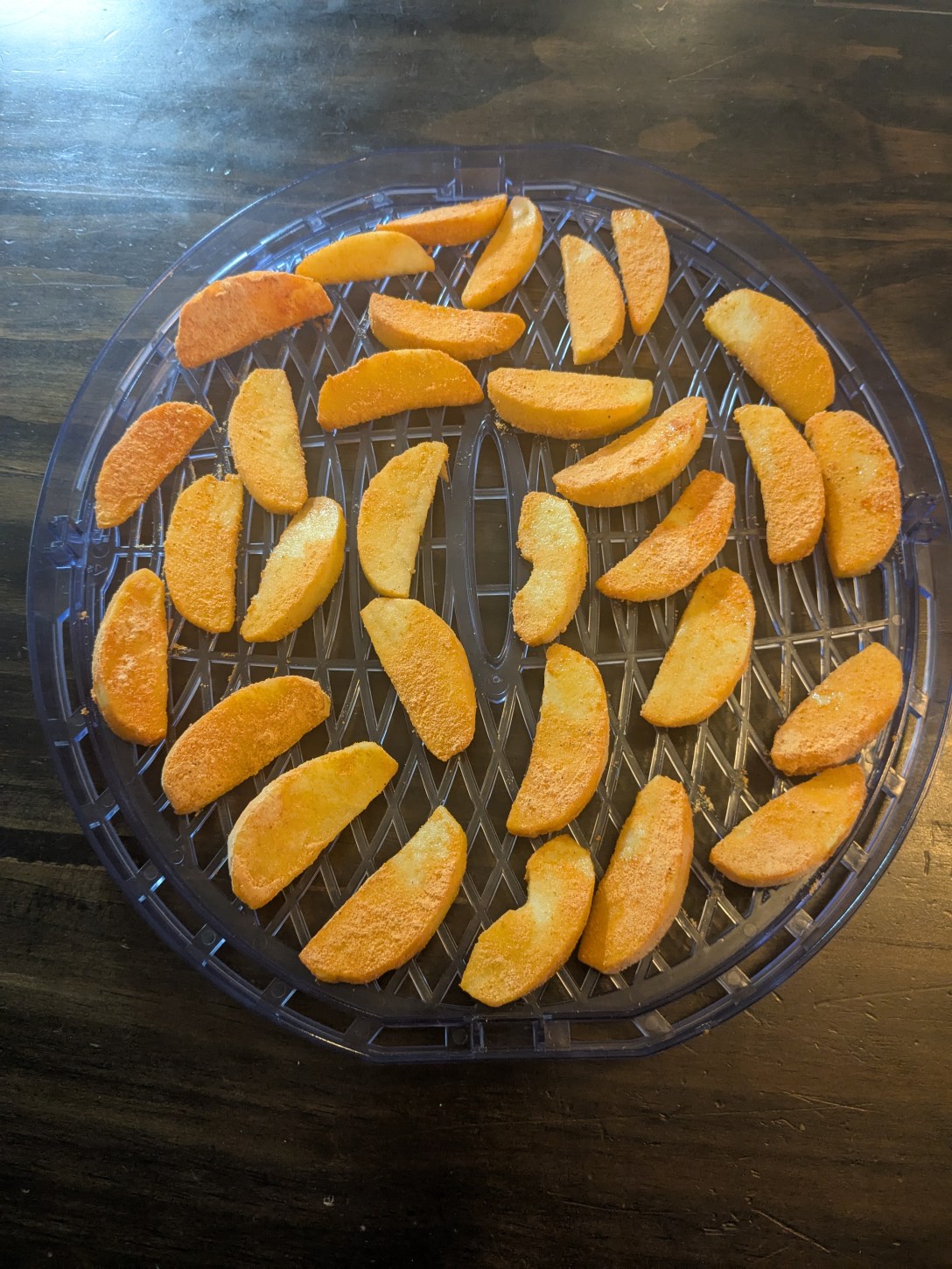
That’s right, I used popcorn seasoning. I wasn’t sure if the nacho cheese flavoring would be too overpowering, so I did a 50/50 blend of the cheese and the butter toppings (about a tablespoon of each for 2 smaller apples).
Not only do they look like cheddar cheese snack, they taste like them too. They are awesome, so if you have a dehydrator, I highly recommend trying this method. It might, as my wife likes to say, “take some of the healthy” out of the apples, but who cares when they taste this good?

A new Guitar Design – Part 4

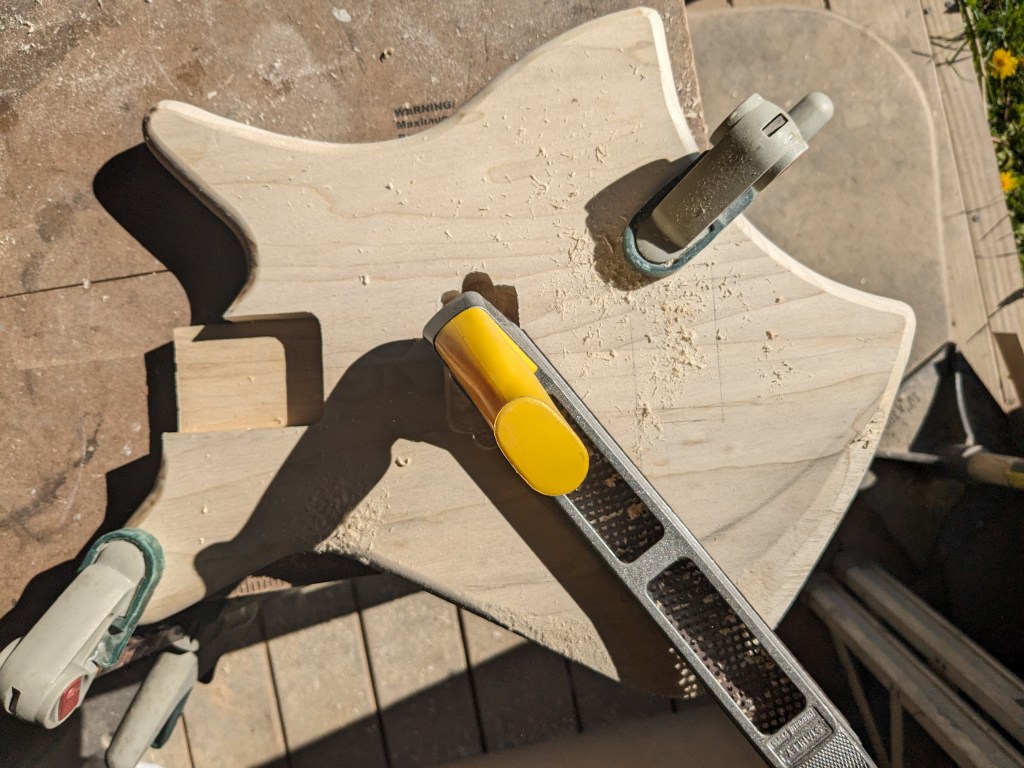
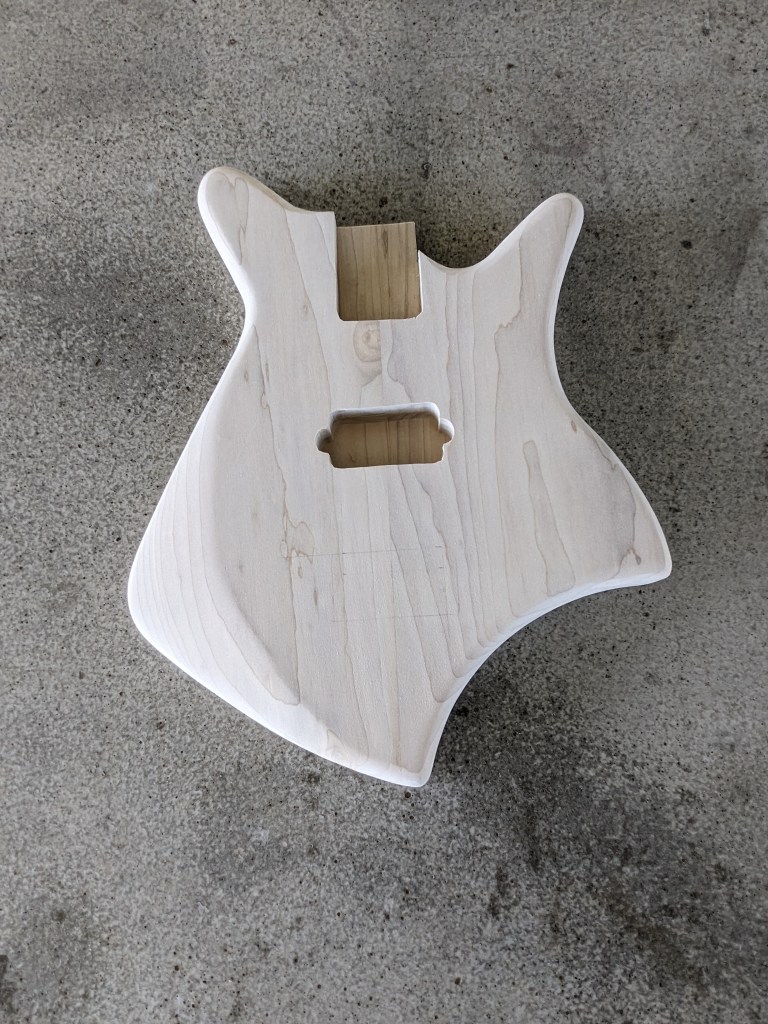
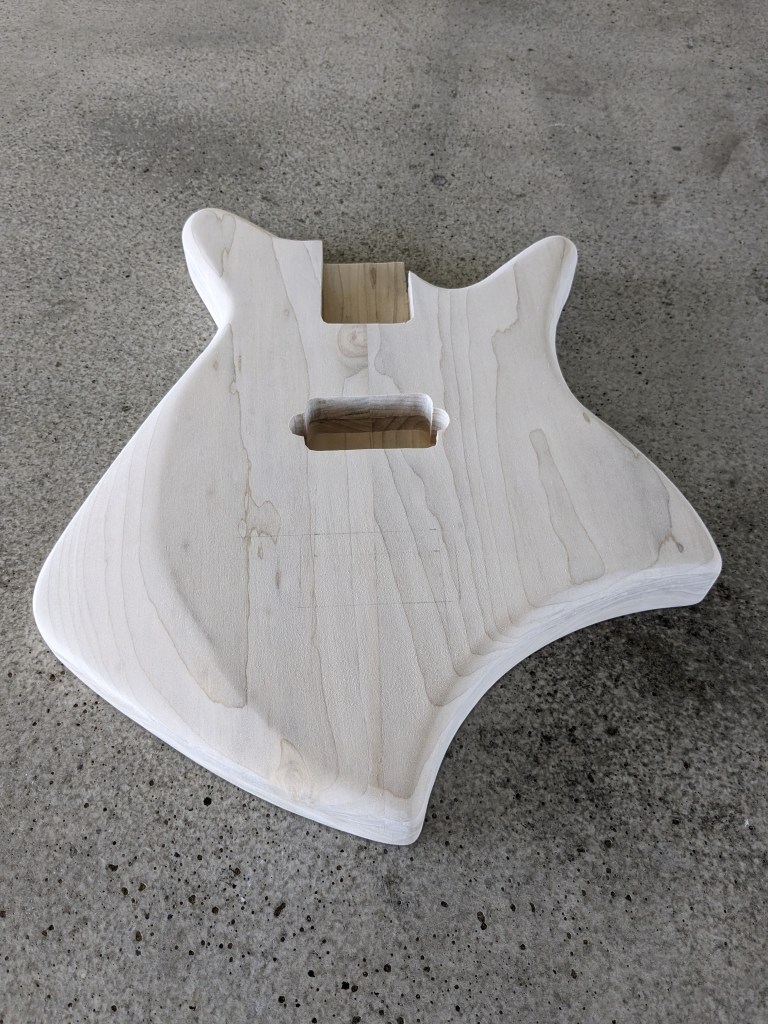
Once I had the body glued up, it was time to shape and sand it. I started by rounding over the edges, then got to work with a rasp to start contouring the arm rest area. This will reduce the weight a little and making it more comfortable to play.

Once I had the contouring done, I drilled for the volume and tone pots, the jack, the bridge (including the grounding wire channel, and the neck screws.

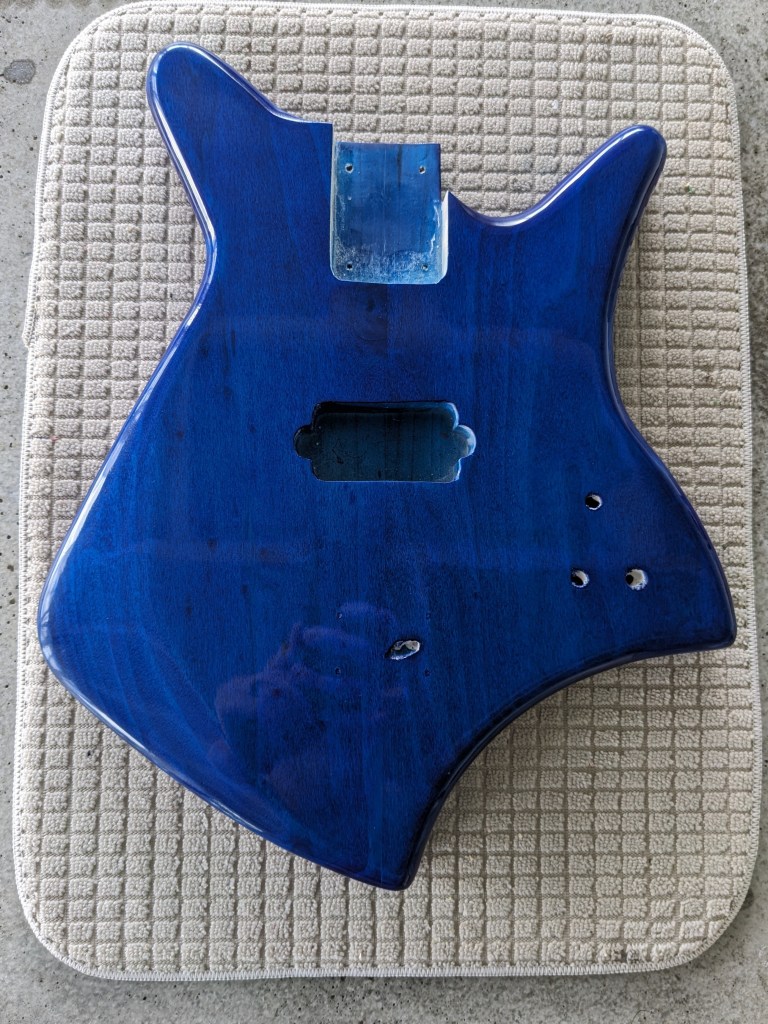
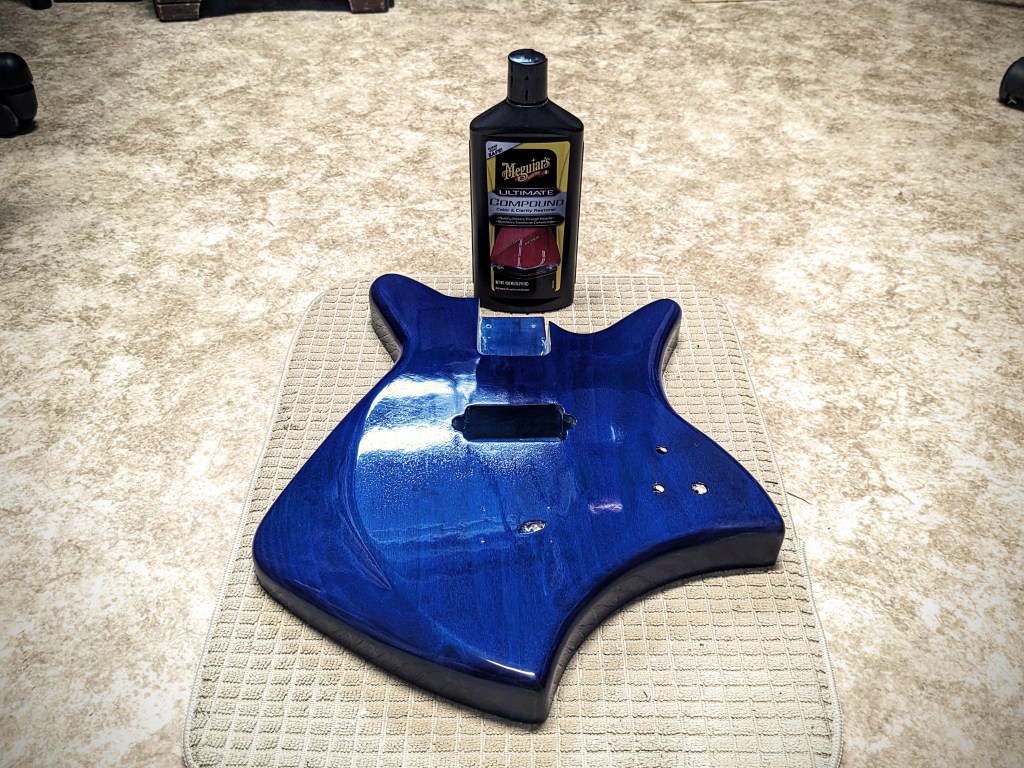
I didn’t take any pictures of the sanding process, but once it was done, it was time to add a little color. I really wanted to blue to stand out on this one so I started by staining the body with ColorTone liquid stain. This alone is usually good enough, but I wanted to enhance this with Metalcast Blue Anodized coating. This is a translucent blue finish meant to go over chrome or bright metal, but it works just as well over wood. I topped this off with Rust-Oleum Triple Thick Glaze. I gave each of these layers ample time to cure between coats, then let the whole stack rest for a week before wet sanding and polishing with Meguiars compound.

Next is final assembly and setup!

A new Guitar Design – Part 3

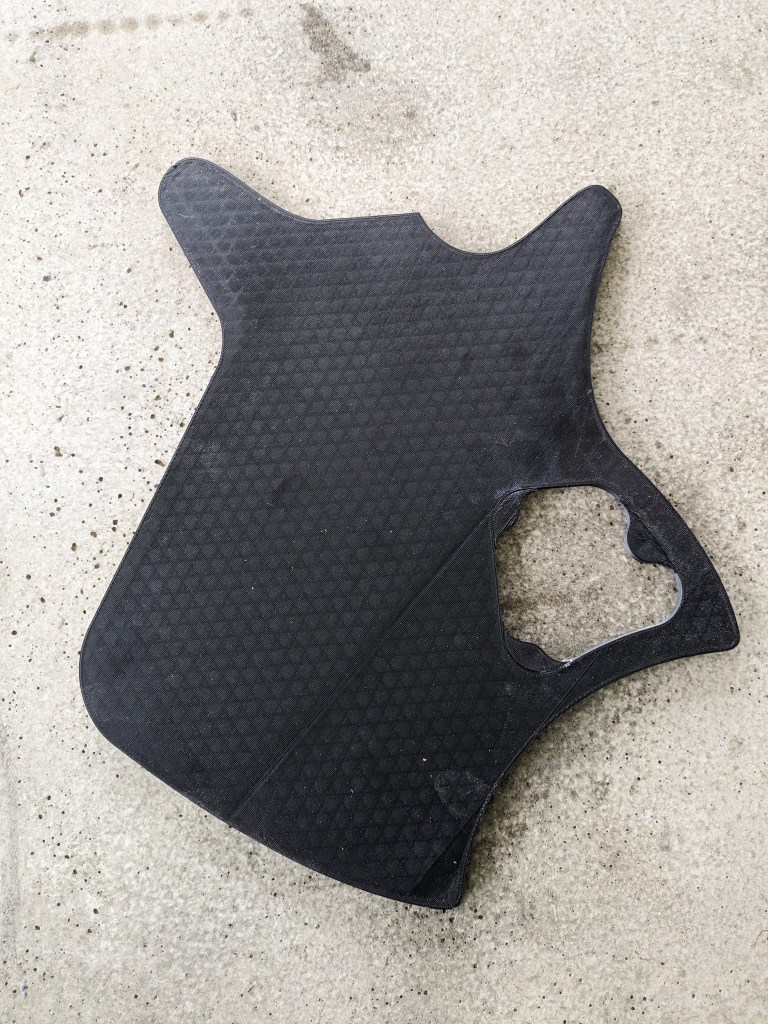
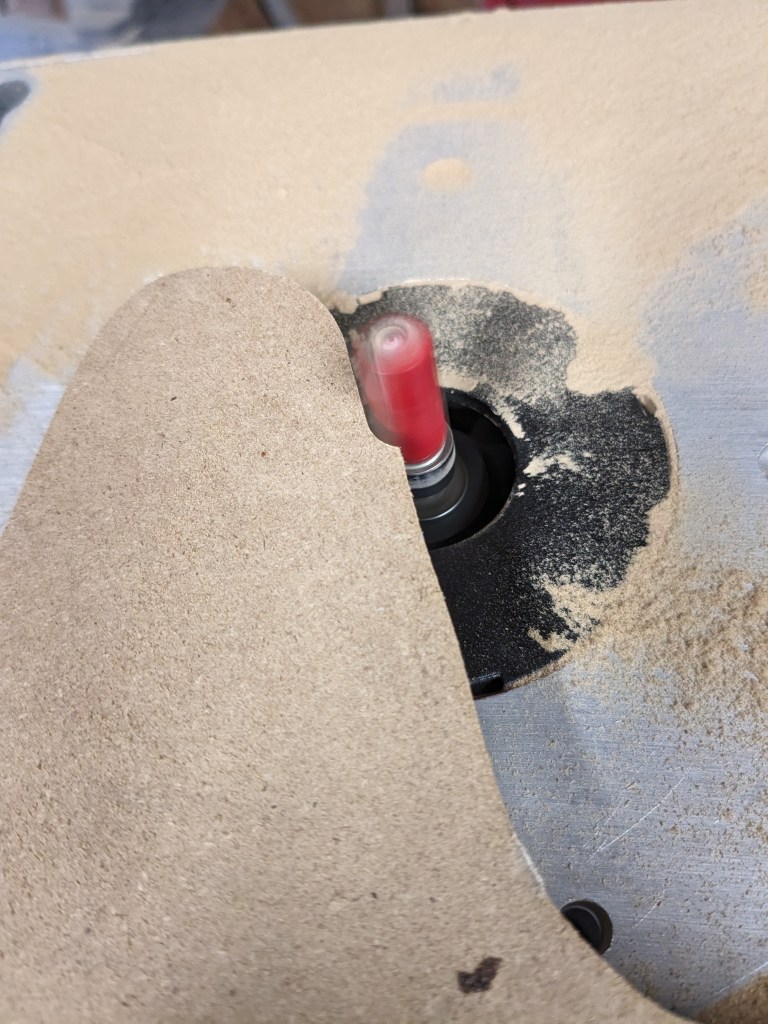
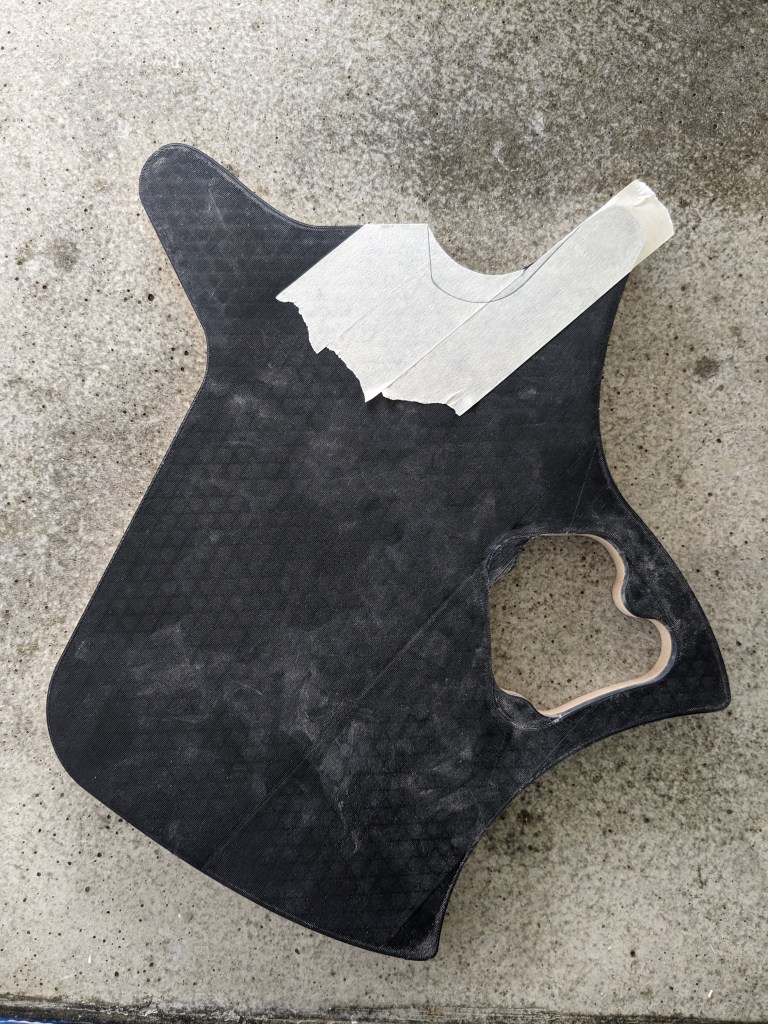
Once I had my design modeled in Fusion 360, I modeled the routing jigs I would need, and started 3D printing them. This included the body templet with the control cavity cutout and the control cavity cover routing templet. These are printed 1/4″ thick, then I use double sided “carpet” tape to adhere them to 1/2″ MDF and route to make a template that is 3/4″ thick. I do this because the 3D printed template is susceptible to heat. Routing the mdf doesn’t produce a lot of heat, but trying to rout 3/4″ or 1.5″ poplar does, and can actually start to deform the 3D printed plastic.

While the templates were printing, I glued up the blanks for the body, which you can see in the second picture. I took a 1″x8″x6′ poplar board and cut it into four 18″ long pieces, then edge glue two pieces together for the top and two pieces together for the bottom. then I planed them . Unfortunately, I didn’t take any pictures of this process.

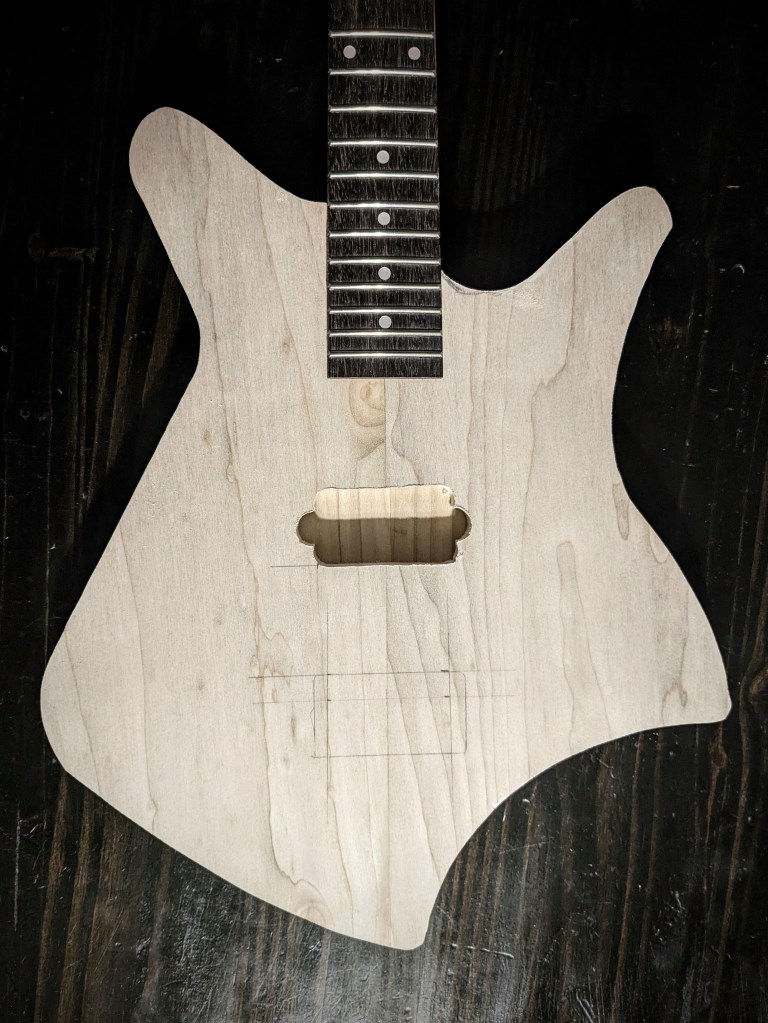
Once the blanks were ready, I traced out the template onto them and used a band saw to cut them almost to size. Then, routed exactly to size. At that point, I couldn’t resist a little mock up with the neck. This allowed me to layout the neck pocket, pickup cavity and bridge placements.

After mocking up the guitar, I realized that the cutout didn’t quite allow enough access to the lower part of the fretboard, so I freehanded a deeper cutout.

With the majority of the cutting and routing done, I glued up the top and bottom halves, using almost every clamp I own:

This is a part I definitely didn’t want to rush, so at this point all I could do was wait.

A new Guitar Design – Part 2

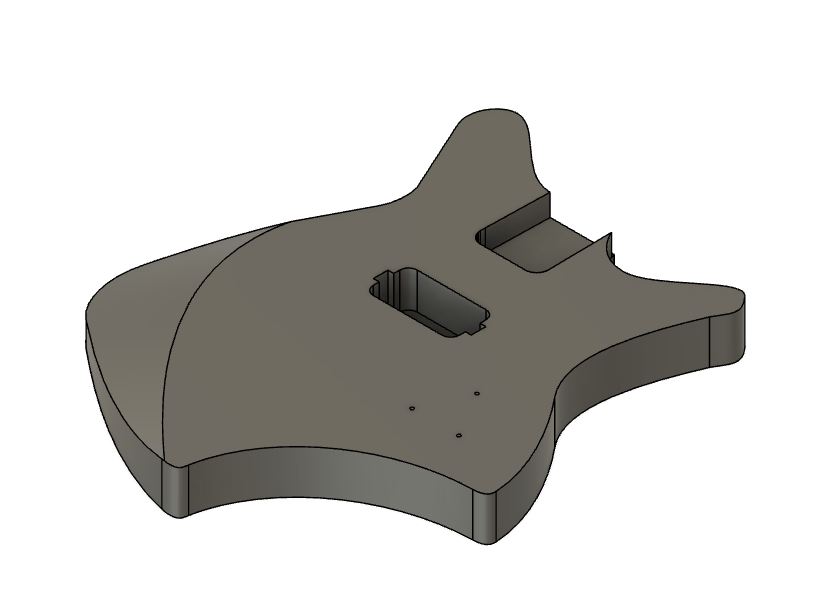
Once I had the basic 2D design established in Adobe Illustrator, I exported it as an SVG file so I could import it into Autodesk Fusion 360. Even though svg files are vector graphics, there is a discrepancy in how Illustrator and Fusion understand the size based on pixels. Illustrator treats the file as 72 dpi and fusion expects 96 dpi, so when importing an svg from Illustrator to Fusion you have to scale it 72/96% or a factor of ~1.33333.

Once imported, I extruded the body, then decided on the control cavity shape, the pickup routing cavity and the neck routing. In designing this guitar, I had a few criteria in mind. I wanted this guitar for playing heavy metal music, which meant I wanted a powerful humbucker pickup. A few years ago I used a BK2000 in a build. This is a quad rail pickup rated at 18 kilohms and has wiring so it can be split, making it even more versatile. I’d even bought an extra one at that time, so it was a no brainer to use it on this build.

Another criteria was the size. I wanted this to be as small as possible while remaining a full size guitar. In other words, I wanted it to be light, and compact to make it as easy and fast as possible to play, which really made me reconsider scale length. Scale length is the distance from the nut (top of the neck where the strings rest) to the bridge (part on the body that holds the strings. Manufacturers have used various scale length over the years, but Fender really standardized the 25.5″ scale length, and this is what I’ve used for all of my six string guitars so far. Lately, though, I’ve found that I really prefer a 24″ scale for my 3-string guitars, so I decided to use it on this design as well. Some manufacturers have sold 24″ scale guitars in the past as “student models”, so I am optimistic that this guitar should be easy to play.

Once I knew what pickup and neck I was going to use, I was able to place the cavities for these:

Next was the control cavity. Even though I was only going to have a push-pull Tone pot, Volume pot and jack, I wanted a large cavity to help reduce weight. I also wanted to to be easy to route, so I designed everything with a half-inch router bit in mind. This is what I came up with:

When I had the design done, I 3d-printed the routing templates and was ready to start the build!

A New Guitar Design Process

It’s been a a while since I posted on here, and though I am continuing to write, I don’t really have much to report on that, other than the fact that you can download “My Grim Life” FREE from Amazon through Monday 4/22/24. After that it’ll go back to the usual $2.99 price for the Kindle version.

Since I don’t have much to discuss on the writing front, I decided it was time to document my process for designing and building a guitar. I’m really excited about this one, because I woke up several times dreaming about this guitar. I have not completed the prototype, but I will be posting as I work on it, starting with the design process.

I’ve really been listening to a lot more metal lately, especially metalcore, which is something I have not played, so I wanted to design and build a guitar focused on playing this type of music. I wanted something that looked the part, but was light and easy to play. Since I already had a killer look floating around in my head, the next part I needed was to design it to scale, and make to sure it not only looked good, but was also usable. I decided on a shorter 24″ scale, in hopes of making it play a little faster than the standard 25.5″ fender scale. I use this scale on my 3-string builds, and it feels very natural to me, so I hope it’ll feel the same for this 6-string design.

I really should start doing this design work in a CAD program (I have Fusion or Solidworks), but I was a graphic designer for years, so Illustrator is still my go-to for initial design conception. I tried a few different things in Illustrator, and probably spent at least 8 hours tweaking paths and dimension, before finalizing the design for the RG36 Metalcore body. What do you think?

It’s Live!

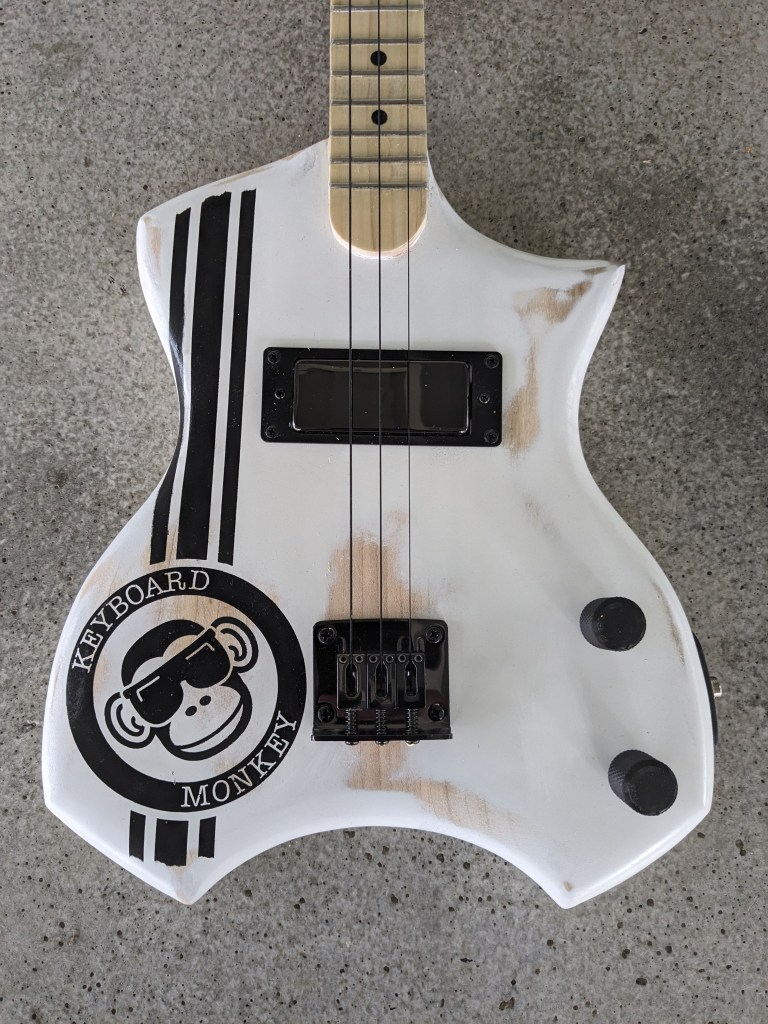
My Grim Life is now available in paperback and on Kindle! I want to send a big THANKS! to everyone who pre-ordered, and who has ordered since. Unfortunately, the signed copies are not quite live yet, because I have yet to receive the paperback copies to actually sign. Right now they are scheduled for delivery on the 9th, and I hope to have them setup for sale on the Keyboard Monkey store ASAP. In the mean time, My Grim Life has taken over the Riley Custom Guitar shop, with (3) book inspired 3-string guitars available. The Perfectly Punk RG13 guitar sports the Keyboard Monkey logo, the Totally Punked Out RG10 has the My Grim Life lettering on the front and the skull logo on the back, and the Grunge Gunner ammo can guitar has the Lettering and logo. Each guitar will ship with a signed copy of the book as well. Future plans include a hardcover version of the book as well as a special guitar giveaway. I hope to have both of these ready in time for Christmas.

Please let me know which guitar is your favorite.

My Grim Life

That’s right, the book has a new title.

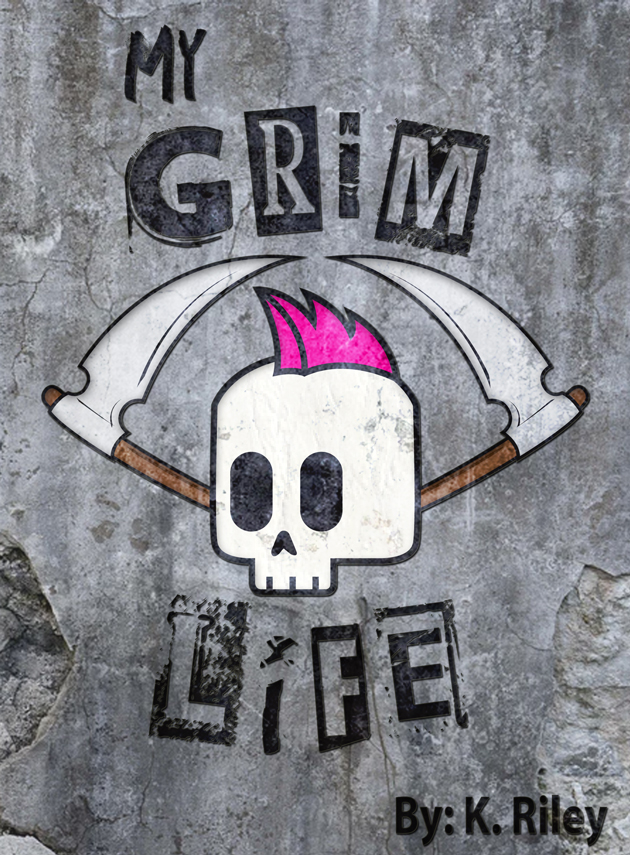
My Life As Death was the working title from the moment I started writing the book. I loved the juxtaposition of Life and Death, but the title never really rolled off your tongue like I wanted. As one person stated, “You have to think about it”. That’s not always a bad thing, but I was just never quite satisfied with it. Then, a few weeks ago, a google search showed another book by that name. Now, a lot of books share names, and there’s nothing wrong with it. And the other book is a novella that shares nothing in common with my book, but from a marketing perspective it really was best to change it. So let me introduce the new cover, sporting the new title. What do you think?

And the guitar? Well, the black, “Totally Punked Up” RG10 3-string guitar is the first in a series of guitars for the book, and for the beginning of Keyboard Monkey Publishing. More details will be released in the near future about all the guitars, the book and how you can purchase them, so stay tuned.

What Now?

After getting kicked out of high school, I never thought I’d go to college. Ten years later I convinced myself to pursue a degree in Computer Application Development in order to have a career that would better provide for my family. The funny thing is, that by the time I completed that degree my career took off in a completely different direction, focusing on graphic, color and material, and CAD design. I worked with a lot of great people and had a lot of great experiences, but after 20 years with that company, I felt a need to change direction, so in 2018 I left, unsure of what was next. Freelancing provided time for me to pick a direction, but Covid really was the catalyst that made me decide to go back to school and pursue a second degree, this time focusing on Mechanical Engineering Technologies. And I am pleased to say that Monday night was my final class for this degree. The final grades haven’t been posted yet, but for all intents and purposes, I am done. In a funny twist of fate, my career decided to take a little different direction about six months ago, and even though I am in an engineering position, my main projects are more focused on Computer Application Development then on Engineering Technologies, but I love the job and the company, so it all worked out. The only question is, “Now what?” For the last couple years I have structured my life around school, so now that I’m done, I will have to decide what projects I want to focus on the most (besides the projects directed by the wife). The guitar building is still going strong so I know I will continue working on them, but I don’t think I’m going to dedicate a whole lot of additional time to that pursuit. I enjoy it, but I feel I’ve been spending the right amount of time on it. What I have not been spending enough time on is my writing. MLAD has been done for quite a while, but I really haven’t done anything with it yet. It’s time to get it out in the world. And while I have been working on the sequel, it’s only about half done, and I plan on having it completed this year. I also plan on finishing the sequel to The Consciousness Puzzle soon. In order to do this, I’m going to have to spend a lot more time with my butt in the chair, pounding on the keyboard, so I guess that’s my plan going forward…Butt in chair, hands on keyboard. I’m sure I’ll come up with plenty of other, creative projects to fill my time, but I really want to have at least two books out this year, and preferably three. It’s going to be a huge undertaking but I have a lot me free time now, so stick around to see how it turns out.

My Life As Death on Wattpad

Hey Guys! I know many of you read My Life As Death here as I was writing it, but for those who haven’t read it, or those wanting an easy way to read it again, I have put it up on Wattpad here: https://www.wattpad.com/story/255746411-my-life-as-death-a-grim-beginning.

I am still pursuing publishing options for MLAD, but in the mean time, I want to make sure anyone who wants to read it, can. I love this story so I want to make sure it stays available for anyone and everyone. I am also continuing to work on the sequel, but I will not be serializing the continuing adventures of Nate and Weed here, or elsewhere. I’ve got many projects going on so I cannot guarantee I will be able to complete a chapter each week. But I’m starting my final class for my engineering degree, and my career has stabilized, so I do plan on posting a new entry on this blog each week, so stay tuned for updates on MLAD, its sequel, and the other novels I’m currently working on, as well as descriptions of the new guitars I’m building as well.